
समीक्षा
Axial Plasma spray technique is a versatile spray variant capable of depositing conventional powder feedstock and, liquid based fine particle suspensions. In comparison with traditional radially injected plasma spray systems, the axially injected powder particles attain better momentum and greater heat transfer while travelling along the plasma plume. Therefore, the high energy based axial plasma sprayed coatings exhibit good deposition rate and efficiency and, offer possibilities of engineering the microstructure with dense, porous, and cracked features.
Fine structured coatings exhibit improved characteristics than micron-sized coatings. The deficiencies associated with fluidized powder feeding arrangement for injecting fine particles, necessitates the use of liquid-based feeding in the form of either suspensions or solution precursor to form the respective deposits. Improved inflight particle dynamics during axial plasma spraying allows efficient spraying of fine particle suspensions which otherwise are difficult with radial injection systems. Axial suspension plasma spray (ASPS) is an emerging coating technology using fine-sized powder particles suspended in a suitable solvent such as water or ethanol and injected into the plasma flame to get desired microstructure.
Key Features
- Engineered microstructures – porous, dense, columnar, vertically cracked and feathery
- High spray rate
- Relatively thin coatings are possible compared to conventional thermal spray
- Better surface finish
- Wide range of materials — ceramets, ceramics, metals and alloys
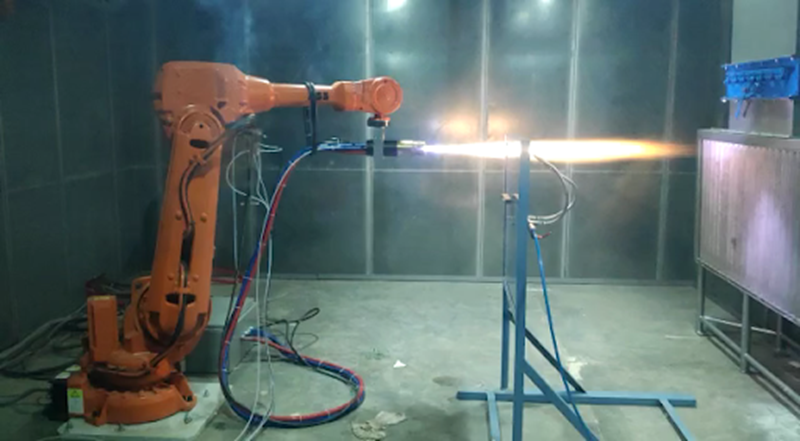
Fig. 1. Axial Plasma Spray in operation
Prominent application areas with axial plasma spray technique include industries requiring thermal barrier, dielectric, insulation, wear, corrosion resistance and refurbishment. For example, YSZ based thermal barrier coatings applied through ASPS exhibit lower thermal conductivity and near-identical microstructure similar to that by EBPVD process, which can be effectively exploited for depositing cost-effective thermal barrier coating solutions in gas turbine components.
Potential Applications
- YSZ based TBCs with diverse microstructure for gas/steam turbine applications
- Pure α-Al2O3 based dielectric coatings
- Dense Cr2O3 coatings for enhanced wear resistance
- Dense Y2O3 coatings for improved corrosion/erosion resistance
- P. Manojkumar, B. Kalyani, D. Vijaya Lakshmi, L. Rama Krishna, G. Sivakumar, Realizing wear-resistant Cr2O3 coatings using finer feedstock: Role of diverse plasma spray torch configurations, Ceramics International, Available online 19 March 2025