
Overview
Micro Arc Oxidation (MAO), also referred to as Plasma Electrolytic Oxidation (PEO), is an advanced and environmentally sustainable surface engineering technique used to form dense, crystalline, and ultra-hard ceramic oxide coatings on lightweight metals such as aluminum (Al), magnesium (Mg), titanium (Ti), zirconium (Zr), and their alloys. The process involves a combination of electrochemical and electrothermal oxidation mechanisms in an alkaline electrolyte under high-voltage, high-current pulsed power, leading to localized micro-arc discharges that facilitate rapid oxide growth.
MAO coatings are extensively explored on aluminum and its alloys, exhibiting up to three times higher hardness, approximately 15-fold enhanced wear resistance, and nearly 10-fold improvement in corrosion resistance compared to conventional hard anodized layers. Owing to these superior functional properties, MAO technology has recently gained commercial application in consumer electronics—for example, the OnePlus 15 smartphone utilizes MAO-coated aluminum for its back panel, reflecting growing industrial interest.
Furthermore, technology has gained traction for magnesium-based components, which offer significant weight reduction potential for aerospace and automotive applications. However, the inherently high reactivity and poor corrosion resistance of Mg limit its usage. MAO significantly mitigates these limitations by imparting high corrosion protection, enhanced wear resistance, and excellent thermal stability, thereby expanding the practical applicability of Mg alloys in demanding environments.
Overall, MAO technology is emerging as a promising and scalable surface modification strategy for lightweight structural materials, attracting increasing attention from sectors such as aerospace, defense, biomedical, automotive, and consumer electronics.
Key Features
- In-situ formation of oxides and spinel structure through the additives to the electrolyte for better corrosion and wear resistance.
- Custom-built technology systems are available in large power supply ranges between 20 to 500 kVA, depending upon the scale of operations
- Non-line-of-sight, economical, and environmentally sustainable process.
- In the case of Al, the coating hardness increases with increasing thickness due to concurrently increased alpha alumina phase in the coating structure
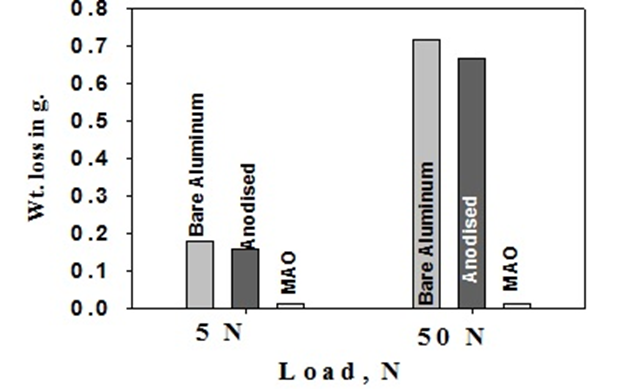
Superior abrasive wear performance of MAO coatings as against the hard anodized coatings against silica abrasive as per ASTM G65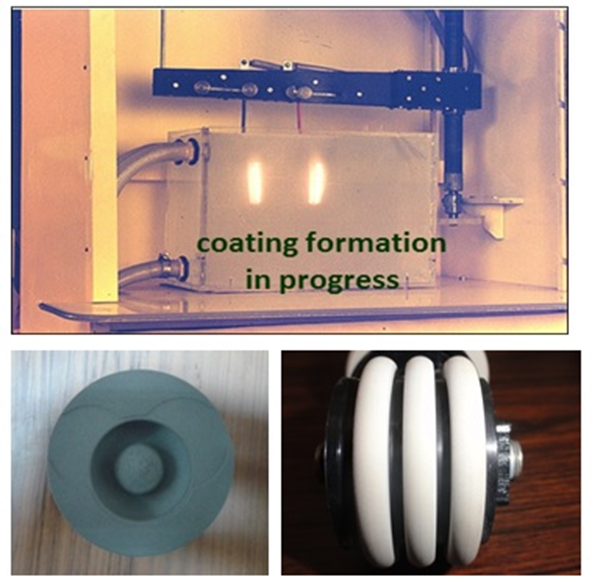
MAO coated heavy duty automotive piston for thermal corrosion protection and textile disc for reducing the friction under high speed, high stress abrasion, sliding wear modes
Potential Applications
- Although the MAO process is discrete, continuous coating deposition technology developed on the basic platform of MAO coating formation is useful for providing an insulating coating on foils and wires of kilometre-long is useful for electrical and electronics applications.
- Leveraging its electrolyte-based and non-line-of-sight nature, the MAO process enables in-situ formation of hard oxide layers at desired locations to enhance wear, corrosion, thermal, and electrical protection. It holds strong potential across multiple sectors, including automotive, aerospace, wire drawing, and textile industries.
Status
- Prototype models of academic and industry scale systems were already fabricated, tested and demonstrated on a variety of applications, installed at customer locations.
- Application development for various industry segments is currently in progress to promote more technology transfers to the Indian industries and universities.
Intellectual Property Development Index (IPDI)
Level
1
2
3
4
5
6
7
8
9
10
Description
Basic concepts and understanding of underlying scientific principles
Shortlisting possible applications
Research to prove technical feasibility for targeted application
Coupon level testing in simulated conditions
Check repeatability/consistency
Prototype testing in real-life conditions
Check repeatability/consistency
Reassessing feasibility (IP, competition technology, commercial)
Initiate technology transfer
Support in stabilizing production
Status
| Level | 1 | 2 | 3 | 4 | 5 | 6 | 7 | 8 | 9 | 10 |
|---|---|---|---|---|---|---|---|---|---|---|
| Description | Basic concepts and understanding of underlying scientific principles | Shortlisting possible applications | Research to prove technical feasibility for targeted application | Coupon level testing in simulated conditions | Check repeatability/consistency | Prototype testing in real-life conditions | Check repeatability/consistency | Reassessing feasibility (IP, competition technology, commercial) | Initiate technology transfer | Support in stabilizing production |
| Status |
|
|
|
|
|
|
|
|
|
|
For more details on Intellectual Property Development Indices, Click here
- Indian Patent Applications: (a) 209817, (b) 1828/DEL/2008/01082008, (c) 1839/DEL/2015, US Patent Applications: (d) 6,893,551, (e) 8,486,237, (f) 9,365,945 UK Patent Application: (g) GB2464378, Japan Patent No: (h) 5442386, German Patent No: (i) 10 2009 044 256, French Patent Application: (j) 0957102, Brazil Patent No: (k) Pl0904232-6 A2 and South Africa Patent No: (l) ZA200906786.
- L. Rama Krishna et. al., Surface and Coatings Technology, vol. 163-164, 2003, pp. 484-490, Wear, vol. 261, 2006, pp. 1095-1101, Surface and Coatings Technology, vol. 167, 2003, pp. 269-277.
- L. Rama Krishna et. al., Metallurgical and Materials Transactions A, vol. 38, 2007, pp. 370-378, Surface and Coatings Technology, vol. 269, 2015, pp. 54-63, Journal of Alloys and Compounds, vol. 578, 2013, pp. 355-361.