
Overview
Activated Combustion High-velocity Air-Fuel (HVAF) spray utilises compressed air and LPG fuel combination to generate high velocity gas streams. The optimized combination of high kinetic energy – ideal thermal input allows deposition of coatings with excellent microstructural features including fully dense, defect-free, retained phases and high adhesion strength. The exceptional capabilities can be understood from its highest productivity amongst the competing thermal spray techniques to reach as high as 35 kg/hr for Cr3C2-NiCr based coatings.
The process involves a pre-mixed Air-fuel mixture fed to the combustion chamber through the ceramic insert which is ignited initially with a spark plug. As the Combustion proceeds, the ceramic insert at the entrance of the combustion chamber gets heated up above the auto-ignition temperature of the mixture and takes the role of spark plug to enable stable combustion (also known as “Activated combustion”) throughout the process. The flame temperature during HVAF is much lower than that of HVOF since it uses an air-fuel mixture instead of an oxy-fuel mixture, which allows HVAF to coat thermally sensitive material with lesser thermal deterioration. Control of gas dynamics through the use of diverse nozzles results in range of particle velocities, which translates into highly adhesive, hard, oxide and pore-free coatings. Prominent application sectors with HVAF technique include industries requiring wear, corrosion resistance and refurbishment.
Key Features
- Capable to generate 200 kW equivalent combustion power to spray wide ranging cermets, alloys and metal powders
- Convertible mode of spraying to deposit higher particle sized powders
- Internal geometry coating capability
- Specialized torch for spraying Carbide coatings and thin wear resistant coatings
- Six-axis Robotic handling
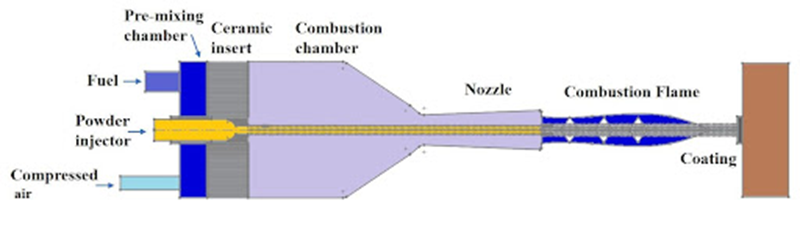
Fig.1 Schematic of HVAF Spray system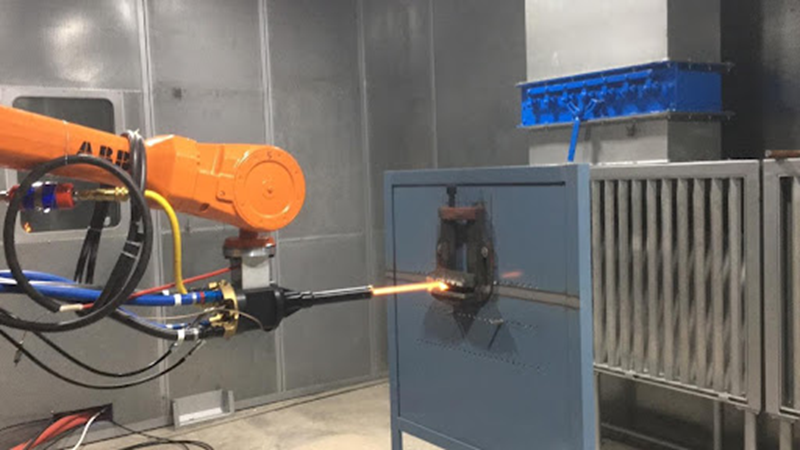
Fig. 2. HVAF Spray in operation
Potential Applications
- HVAF coatings provide superior wear and abrasion resistance, enhancing service life of industrial and mining equipment.
- They offer excellent corrosion and erosion protection, making them ideal for harsh oil & gas and marine environments.
- HVAF enables high-temperature stable coatings, suitable for turbine, power plant, and aerospace components.
- It supports precision dimensional restoration with minimal distortion, extending usability of shafts, rolls, and hydraulic rods.
- HVAF is a sustainable alternative to hard chrome plating, delivering higher performance without environmental hazards.
- D. Vijaya Lakshmi, P. Suresh Babu, Rahul Jude Alroy, G. Siva Kumar, and M. J. N. V. Prasad, “Performance evaluation of thin cermet coatings produced by HVAF spray: A new approach for hard chrome replacement.”
- Rahul Jude Alroy, M. Kamaraj, and G. Sivakumar, “Microstructure, property and high-temperature wear performance of Cr₃C₂-based coatings deposited by conventional and ID-HVAF spray torches: A comparative study.”
- Rahul Jude Alroy, Harita Seekala, P. Sudharshan Phani, and G. Sivakumar, “Role of high-speed nanoindentation mapping to assess the structure-performance correlation of HVAF-sprayed Cr₃C₂-25NiCr coating.”
- Rahul Jude Alroy, M. Kamaraj, and G. Sivakumar, “Influence of processing condition and post-spray heat treatment on the tribological performance of high velocity air-fuel sprayed Cr₃C₂-25NiCr coatings.”
- D. Vijaya Lakshmi, P. Suresh Babu, Rahul Jude Alroy, G. Siva Kumar, and M. J. N. V. Prasad, “Performance Evaluation of Thin Cermet Coatings Produced by HVAF Spray: A New Approach for Hard Chrome Replacement.”
- Rahul Jude Alroy, M. Kamaraj, and G. Sivakumar, “HVAF vs oxygenated HVAF spraying: Fundamental understanding to optimize Cr₃C₂-NiCr coatings for elevated temperature erosion resistant applications.”
- Rahul Jude Alroy, Ratnesh Pandey, M. Kamaraj, and G. Sivakumar, “Role of process parameters on microstructure, mechanical properties and erosion performance of HVAF sprayed Cr₃C₂-NiCr coatings.”
- D. Vijaya Lakshmi, P. Suresh Babu, Nitin P. Wasekar, G. Sivakumar, and M. J. N. V. Prasad, “Electrochemical corrosion behaviour of thin and thick WC–10Co–4Cr coatings deposited by HVAF thermal spray technique.”