Overview
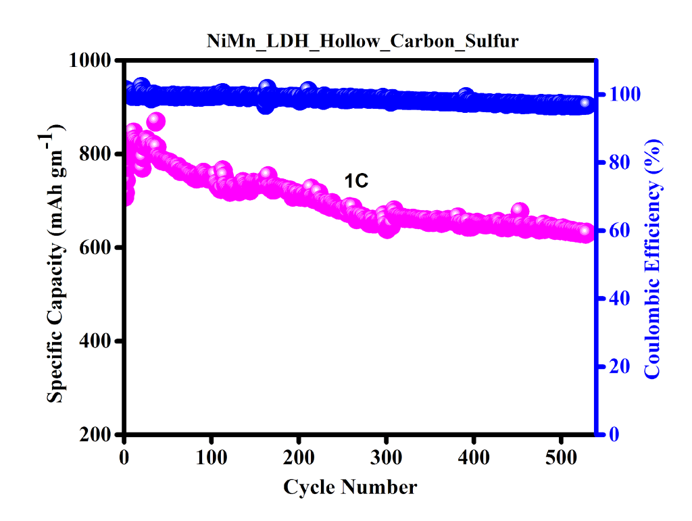
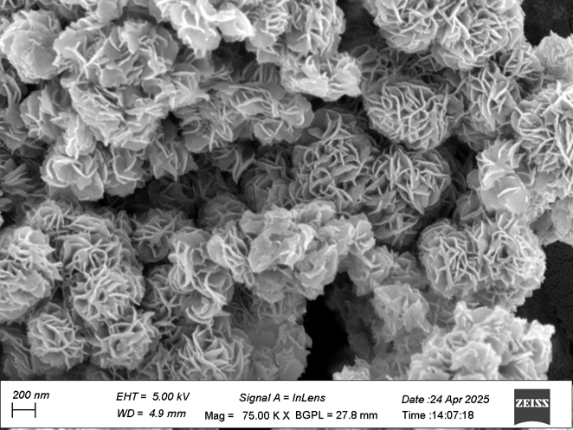
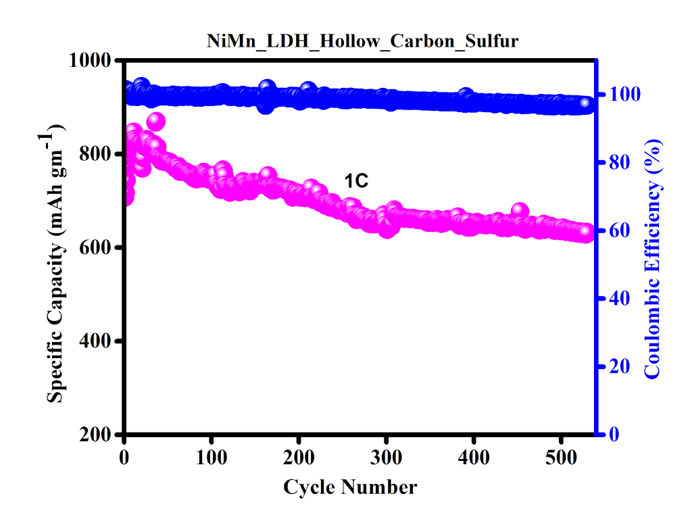
Sulfur, being abundant, low-cost, and environmentally benign, is an attractive cathode material. However, it suffers from inherently low conductivity, large volume expansion during cycling, and polysulfide dissolution, all of which limit its cycle life. To overcome these limitations, ARCI developed a 1T-rich MoS₂ host, where the metallic 1T phase significantly enhances electrical conductivity and provides strong chemical adsorption sites to confine polysulfides. The 1T-rich MoS₂ was synthesized using a hydrothermal method, which enables controlled formation of few-layer MoS₂ nanosheets enriched with the conductive 1T phase. Subsequent incorporation of sulfur was achieved through a melt-diffusion process, ensuring uniform sulfur impregnation within the MoS₂ nanostructure. The method is simple and energy-efficient. ARCI’s MoS₂/S composite demonstrated a high specific discharge capacity (~1200 mAh/g at 0.1C), excellent rate capability, and stable long-term performance due to effective polysulfide trapping by MoS₂. ARCI’s composite exhibits superior cycling, retaining ~74.5% of capacity after 300 cycles at 1 C.
Key Features
- 1T-rich MoS₂ provides high conductivity and strong polysulfide adsorption.
- Effective suppression of polysulfide shuttle and improved sulfur utilization.
- High specific capacity (~1200 mAh/g) with excellent cycle life.
- Cycling stability was performed at 1C, a capacity retention of 74.5 % was achieved after 500 cycles.
Potential Applications
- High-energy battery systems for electric and hybrid vehicles (especially lightweight auxiliary packs).
- Drones require ultra-light, high-energy power sources.
- Grid-scale renewable energy storage and backup power.
- Defense and aerospace systems requiring high-energy, compact power solutions.